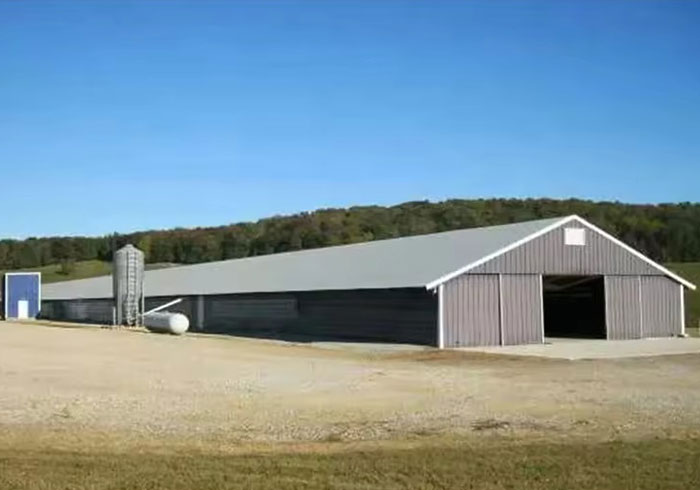
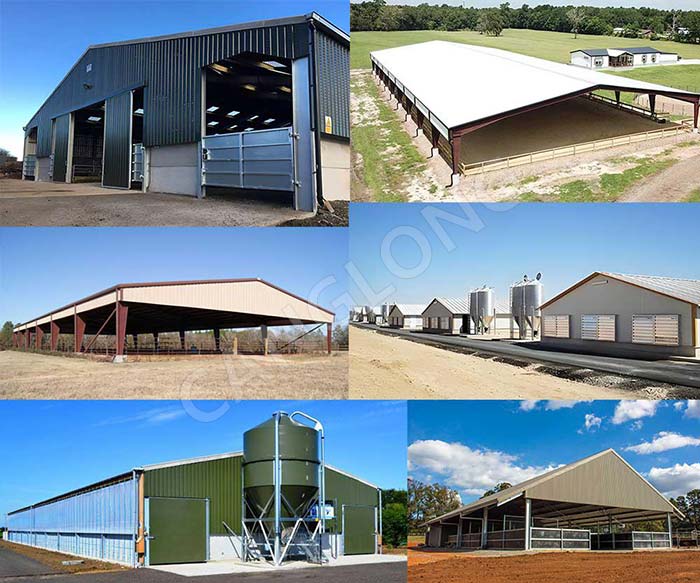
Steel structures aren’t the only option, but they offer a more flexible construction method. Large-span designs can reduce or even eliminate interior columns, providing more complete space for farm machinery, hay, feed, and livestock activities. Prefabrication means that components such as steel columns, beams, and purlins can be prefabricated and assembled on-site, helping to shorten the construction cycle.
This is especially important for agricultural projects in remote areas or those requiring rapid deployment. More importantly, steel structure buildings can be customized for different uses. From simple agricultural warehouses to large machinery workshops, livestock sheds, dairy barns, and integrated agricultural facilities, everything can be designed according to specific needs.
Should farm construction only consider the “present”? This is a question worth discussing. Suppose today a simple farm machinery warehouse is built; five years later, the farm expands and needs more equipment; ten years later, some space may need to be converted into a maintenance workshop or storage area.
Then, should a certain degree of flexibility be considered in the initial design of the building?
This is also a key value of prefabricated steel structure buildings. They don’t just meet today’s needs, but leave room for the future. Building dimensions, spans, doorways, lighting, ventilation, insulation, and internal functional areas can all be planned during the design phase.
Is cost really just the price of steel structures?
When choosing farm buildings, comparing only the price per ton of steel structure or per square meter may not reflect the true construction cost.
It’s more important to focus on the entire lifecycle: “construction cost + construction time + maintenance cost + usage efficiency + later modification cost.”
For example, a building with a more complete internal space may make it easier for large agricultural machinery to enter and exit. Proper insulation and ventilation design can improve the internal environment. Durable anti-corrosion treatment helps reduce long-term maintenance needs.
Therefore, for farmers, the real comparison may not be “which building is the cheapest?”. But rather “which building can continuously create value for many years to come?”
Can steel structure farm buildings be made even more environmentally friendly?
Modern agriculture is also increasingly focused on energy efficiency. Steel-framed buildings can be designed in conjunction with high-performance insulation materials, natural ventilation, skylights, and solar energy systems.
For example, under suitable project conditions, rooftops can be integrated with photovoltaic systems. This allows roofs, originally intended only for shading and protection, to also function as clean energy producers. This means that future farm buildings may not just be “storage space,” but rather a more complete agricultural infrastructure.

Send us the inquiry form