If you only look at the purchase price, sandwich boards may just be a building material. However, from the perspective of investors, owners, and business operators, it is actually a long-term investment that affects the operating costs of a building for decades to come.
The real cost of a factory, warehouse, or cold storage facility does not only occur during the construction phase. From design → procurement → construction → energy consumption → maintenance → renovation → demolition, the building incurs continuous costs throughout its entire life cycle.
Therefore, the real comparison is not “which wall panel is cheaper per square meter?”. But rather “which building envelope system allows the building to cost less over its entire life cycle?”. This is the core value of the Life Cycle Cost (LCC) of sandwich panels.
I. The Construction Industry is Shifting from Initial Cost to Life Cycle Cost
A significant change is taking place in the global construction industry. The 2026 UNEP and GlobalABC “Global Status Report for Buildings and Construction 2025–2026” indicates that the construction industry accounts for approximately 11%–13% of global GDP, while also contributing about 28% of global energy consumption and 37% of global emissions. The report also states that global investment in building energy efficiency needs to reach approximately $5.9 trillion by 2030 to better align with net-zero emissions targets.
This means that the evaluation criteria for future building investments are changing:
Past: Was the initial investment low?
Now: What is the total cost including construction costs, energy costs, maintenance costs, service life, and retrofitting costs?
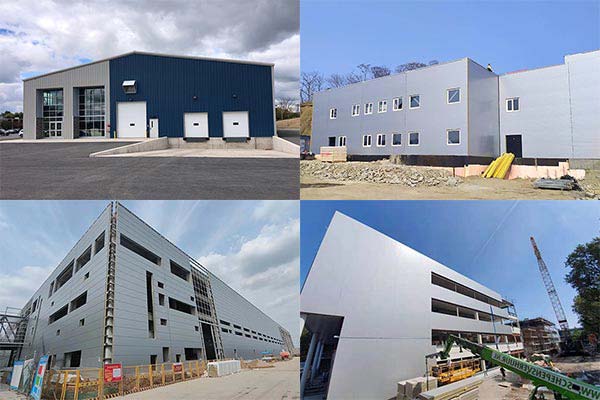
This change is particularly pronounced for industrial plants, warehouses, cold storage facilities, and food processing buildings.
II. The First Cost Advantage of Sandwich Boards: Reduced on-site construction costs
Traditional walls typically require masonry → leveling → insulation → plastering → finishing, with different processes requiring different personnel and time.
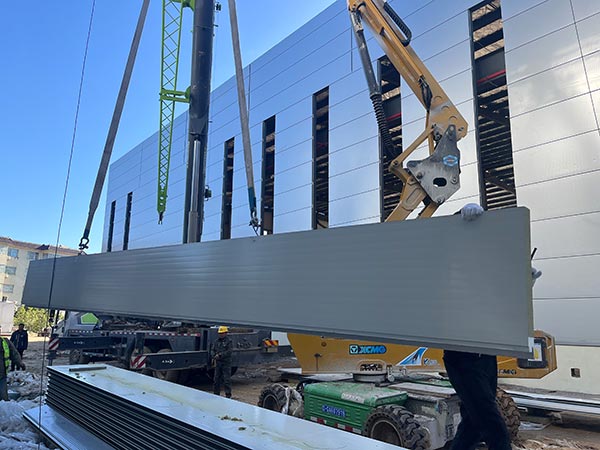
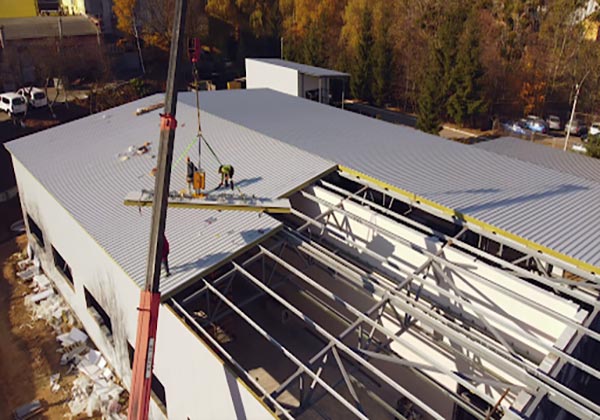
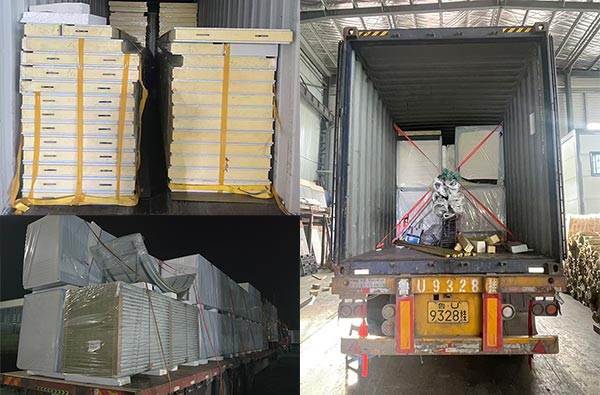
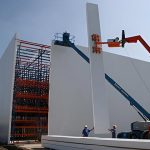
Sandwich boards are manufactured in a factory and assembled on-site. The insulation core and metal panels are composited in the factory and can be installed immediately upon arrival at the site. This means:
Less on-site wet work;
Fewer construction steps;
Shorter installation time;
Less on-site labor requirements.
For large industrial buildings, a shorter construction cycle is itself an economic benefit. Extended construction periods mean increased labor costs, equipment rental costs, on-site management costs, and longer capital tied up in inventory.
Therefore, the value of sandwich panels lies not only in the price of the panels but also in how quickly they help projects complete the building envelope construction.
III. The Second Cost Advantage: Insulation performance impacts energy bills for decades.
This is perhaps the most easily underestimated value of sandwich boards. International Energy Agency (IEA) data shows that buildings account for approximately 30% of global energy demand. For building energy conservation, improving the insulation performance of the building envelope and reducing unnecessary heat transfer are crucial measures to improve building energy efficiency.
For industrial plants and warehouses, walls and roofs are not simply “shells.” They are actually “thermal barriers” between the building and the outside world. If the building envelope has insufficient insulation:
High-performance sandwich panels can reduce heat transfer through continuous insulation core material. Therefore, building material purchase costs only occur once, but energy costs can continue for decades. This is why investors cannot only compare material purchase prices.
IV. The Third Cost Advantage: Turning Material Costs into Operating Cost Savings
Assume two warehouses have the same building area.
Option A: Initial building envelope price is lower, but insulation performance is average.
Option B: Initial investment is slightly higher, but insulation performance is better.
If only the purchase price is considered, A may be more attractive. However, if the time frame is extended to 10, 20 years or even longer, B may gradually offset the initial investment difference by reducing the energy demand of heating, cooling, and air conditioning systems.
Existing life-cycle cost studies also indicate that steel structure buildings using energy-efficient sandwich board, even with slightly higher initial costs, may still exhibit a significant economic advantage in long-term life-cycle cost comparisons. Therefore, for investors, cheap materials do not necessarily mean cheap buildings.
V. The Fourth Cost Advantage: Reduced Hidden Expenses from Maintenance and Replacement
During building operation, there is another often overlooked maintenance cost. Wall leaks, roof aging, insulation damage, and panel corrosion can all lead to repair → downtime → replacement → labor → materials → secondary construction. Especially in industrial buildings, a single repair may involve more than just material costs.
It can also affect:
Production lines
Warehouse operations
Cargo safety
Business operations
Therefore, selecting appropriate wall and roof systems during the design phase essentially reduces future maintenance risks.
Of course, the actual lifespan and maintenance needs of sandwich boards are affected by factors such as panel quality, coating, core material, environment, installation quality, and maintenance methods. Therefore, it cannot be simply assumed that all sandwich panels have the same life-cycle performance.
VI. Fifth Cost Advantage: Different Core Materials to Match Different Investment Goals
Sandwich boards are not a single product. Different core materials can be selected based on the building’s intended use and performance requirements.
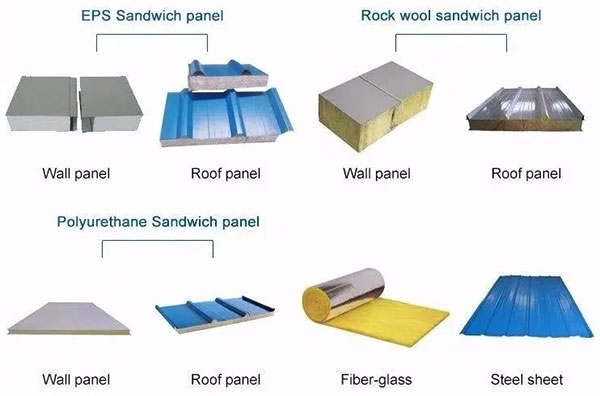
EPS Sandwich Panels: Focusing on economy and rapid construction, suitable for general warehouses, typical industrial plants, and budget-sensitive projects.
PU Sandwich Panels: Focusing on thermal insulation and energy efficiency, suitable for cold storage, food processing plants, and temperature-controlled buildings.
PIR Sandwich Panels: Focusing on thermal insulation and higher fire resistance requirements, suitable for industrial and commercial projects with high overall building performance requirements.
Rock Wool Sandwich Panels: Focusing on fire resistance and thermal insulation, suitable for industrial buildings, warehouses, and public buildings with high fire safety requirements.
Therefore, the truly professional choice is not “Which sandwich panel is the best?”. But rather, “Which sandwich panel can meet the building’s performance needs for decades to come with a reasonable initial investment?”
VII. What Investors Should Really Calculate are These 5 Costs
When comparing two building envelope systems, it’s advisable not to only look at the price per square meter. A Low Cost of Construction (LCC) analysis can be performed using the following logic:
Includes: Demolition + Recycling + Waste Disposal + Building Upgrades.
Only by considering all these costs together can the true investment value of building materials be seen.
VIII. Why is Insulation Becoming a Key Direction for Global Building Investment?
Global building area continues to grow. According to data from UNEP and GlobalABC, the global building stock reached approximately 273 billion square meters in 2024, representing a year-on-year increase of about 1.7%. Meanwhile, global investment in building energy efficiency still needs significant improvement.
The IEA also points out that with the increase in new building construction and the rise in high temperatures, emerging and developing economies are increasingly demanding efficient building designs and cooling systems. This means that future buildings will not only need to be more numerous but also more energy-efficient.
As a crucial component of the building envelope, the insulation performance of walls and roofs will receive increasing attention from owners, developers, and investors.
IX. The True Value of Sandwich Boards: Making Buildings Faster, More Economical, and Easier to Maintain
If we reorganize the advantages of sandwich panel, we can see that they are not just an insulation product. They actually solve several long-standing problems in the construction industry simultaneously.
Factory prefabrication → Reduces on-site construction time
Lightweighting → Reduces transportation and installation difficulty
Continuous insulation → Improves building thermal performance
Multiple core materials → Adapt to different building needs
Industrialized production → More controllable product quality
This is also a key reason why prefabricated and industrialized buildings continue to receive attention.
X. Truly smart investment is not about buying the cheapest materials
For an investor preparing to build a factory, warehouse, logistics center, cold storage, food processing plant, or auto repair shop, the most important question should not be “Which panel is the cheapest?”.
But rather, “Which building envelope system will allow me to spend less money over the next 20 years?”
These two ways of thinking, seemingly differing only by one sentence, actually represent completely different investment logics. The former focuses on purchase price, while the latter focuses on return on investment.
Conclusion
The cost of a building never ends on the day of construction. A building may be used for 20, 30 years, or even longer, and the building envelope system will continuously affect its energy consumption, indoor environment, maintenance frequency, operating costs, and asset value. Therefore, when choosing sandwich board, you shouldn’t just compare the price per square meter, but rather calculate the initial cost + construction cost + energy cost + maintenance cost + end-of-life cost. This is the true total life-cycle cost.
Future construction investment will increasingly shift from buying materials to buying long-term value. Sandwich boards are not simply about sealing off walls and roofs. They continuously impact your operating costs every day after the building is completed.
So, what’s truly worthwhile to invest in is never the cheapest building materials, but rather building systems that create higher value throughout their entire lifecycle.

Send us the inquiry form