prefabricated steel buildings due to their inherent flexibility and resilience, can absorb and dissipate the enormous energy of seismic waves through slight deformation during an earthquake, thus ensuring they do not collapse even in a major earthquake and protecting the safety of people and property inside.
The Earthquake-Resistant Advantages of Steel Structures
In earthquake-prone regions worldwide (such as Chile, Japan, Turkey, and along the Andes Mountains), prefabricated steel buildings are rapidly replacing traditional concrete buildings, becoming the standard configuration for industrial and commercial infrastructure.
1. Resilience
Physical Properties: Steel has extremely high ductility. In strong earthquakes, concrete structures are prone to fracture due to their “hardness and brittleness,” while steel structures, like springs, can displace within a certain range without collapsing entirely.
Energy Dissipation: The joints of steel structures are designed as “fuses” that absorb seismic energy, effectively reducing the impact force transmitted to the main structure.
2. Lightweight
Scientific Logic: The magnitude of seismic force is directly proportional to the mass of a building.
Comparison: The weight of prefabricated steel structure is typically only 1/5 to 1/10 of that of traditional concrete structures. This means that under the same intensity of an earthquake, steel buildings experience significantly less destructive inertial force, and the foundation load is also lighter.
3. Precast Precision
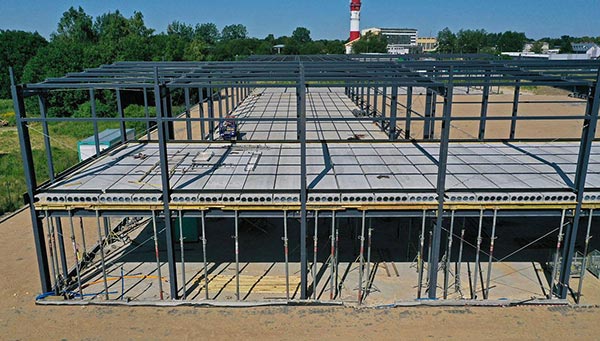
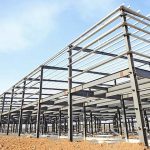
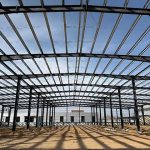
Factory-Controlled Production: Every component (beam, column, support) of a prefabricated building is manufactured in a factory using precision CNC equipment, resulting in extremely high precision in welding and drilling.
Construction Consistency: On-site connections are made only with high-strength bolts, avoiding human factors that commonly cause structural fragility in traditional construction, such as rebar displacement, uneven concrete mix proportions, or insufficient curing.
Canglong Group’s Tailor-Made Safety Standards for Earthquake-Prone Zones
Canglong Group boasts years of practical experience delivering projects in earthquake-prone countries such as Chile and Peru. Our solutions are more targeted:
Q355B High-Strength Steel: Utilizing low-alloy high-strength structural steel, combining high strength and high toughness, it is the core guarantee for seismic design.
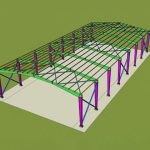
3D Seismic Modeling: Canglong’s engineering team uses digital modeling technology to conduct pressure simulation analysis based on historical earthquake records of the client’s location, optimizing the layout of tie rods and inter-column supports in the structure.
Integrated Complete Kit: We provide not only the framework but also an insulated sandwich panel enclosure system designed to accommodate displacement. These panels have a certain degree of displacement adaptability during earthquakes and will not easily crumble and fall like brick walls, causing secondary damage.
Conclusion
In earthquake-prone zones, safety is not a choice, but a responsibility. prefabricated steel buildings, with their superior physical performance and industrialized quality assurance, have become the recognized optimal solution for earthquake resistance.
Canglong Group is committed to bringing advanced steel structure technology to every corner of the world, helping global clients build industrial fortresses that remain rock-solid even on turbulent terrain.
Does your region have specific seismic fortification requirements? Canglong Group can provide you with a free preliminary structural compliance assessment.



Send us the inquiry form