In 2026, a year marked by frequent extreme weather events, buildings worldwide are facing unprecedented survival challenges. From super hurricanes in the Caribbean and frequent earthquakes along the Pacific Ring of Fire, to extreme blizzards in high-latitude regions and the chronic corrosion from high-salt fog along the coast.
Faced with these natural disaster-level harsh environments, modern prefabricated steel building, thanks to breakthroughs in both materials science and structural engineering, have evolved from traditional shelters to highly resilient, intelligent air-raid shelters. The following is an in-depth technical analysis of how modern steel buildings withstand extreme weather.
I. How to mitigate the suction of a 200 km/h hurricane?
In coastal areas or regions prone to tropical storms, the damage caused by hurricanes to buildings is often not due to direct frontal thrust, but rather to the negative wind uplift created by the roof and side walls. This can tear the building’s exterior apart, like opening a can lid.
1. Portal Frames and the Geometric Grid of Substructures
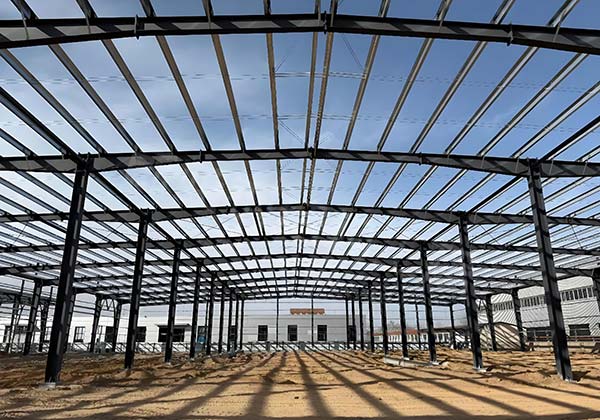
Modern steel building commonly use high-strength Q355B grade H-beams as main steel columns and beams. To withstand hurricanes, engineering designs significantly increase the density of secondary structures, including CNC-machined C/Z-shaped steel purlins, X-bracing, knee braces, and longitudinal tie rods. These components transform a single stress point into a three-dimensional geometric grid, instantly distributing and transferring the massive wind load to the foundation.
2. Anti-overturning technology using concealed joints and windproof washers
In the installation of the external envelope system (walls and roof panels), traditional exposed nail connections are prone to metal fatigue and tearing in wind. Modern engineering prioritizes joint-hidden joint designs. Bolts are completely hidden inside the tongue and groove joints, and large-diameter windproof and shock-absorbing washers securely lock the panels and purlins together. This design, mechanically tested, ensures that the building’s shell remains tightly sealed even under hurricanes with speeds exceeding 200 km/h.
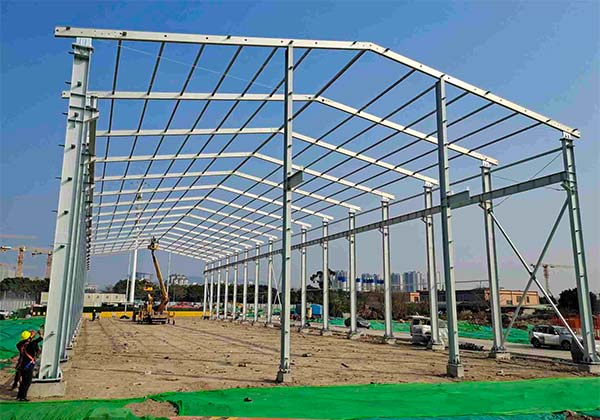
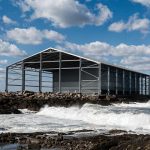
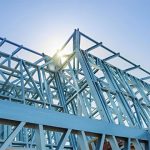
Portal Frame Steel Building
II. Seismic Design
Steel structures possess a natural advantage in seismic resistance. Unlike rigid and fragile concrete structures, steel possesses extremely high ductility.
Buckling-Restrained Braces (BRBs) and Flexible Joints
During strong earthquakes, modern steel structures do not rely on brute force but rather on absorbing and dissipating energy.
Flexible High-Strength Bolted Joints: The connections between main beams and columns are precisely mechanically designed to allow for slight, reversible angular displacement under strong seismic waves. Fine-tuning of the joints buffers the seismic waves.
Energy-Dissipating Bracing System: The building is equipped with buckling-restrained braces (BRBs). Under extreme earthquake conditions, these braces prioritize sacrificing themselves through plastic deformation to absorb and dissipate the destructive kinetic energy of the earthquake, ensuring the stability of the main H-beam and column framework and preventing collapse during major earthquakes.
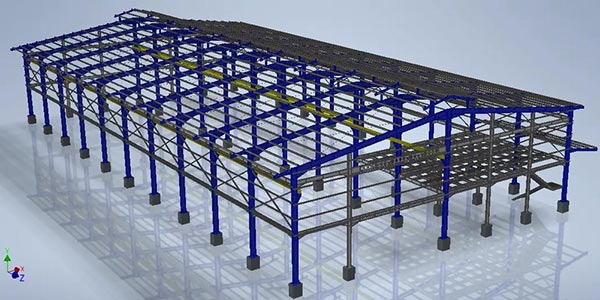
Seismic Design of Steel Building
III. Snowstorm Resistance and Heavy Load Design
In high-latitude, frigid regions, snowstorms present the dual challenges of continuous static loads (snow loads) and indoor condensation.
1. Precise Snow Load Redistribution
For buildings in regions like Canada and Northern Europe, engineers use BIM (Building Information Modeling) to accurately calculate local 100-year snow load data, optimizing roof slopes to guide snowfall naturally. Simultaneously, increasing the density and thickness of roof purlins prevents structural collapse of the roof steel sheets under the long-term pressure of tens of tons of snow.
2. Polyurethane (PU) Energy-Saving Shell to Block Cold Bridges
In extremely cold weather, if insulation materials are inadequate, cold bridges can form in the building’s steel components, causing frost and dripping water on interior walls, damaging indoor equipment.
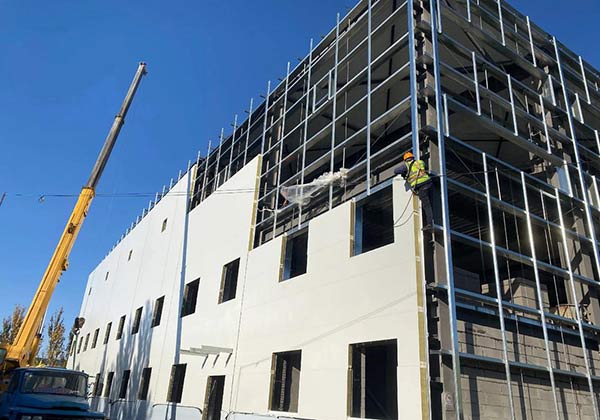
Modern steel buildings are standardly equipped with polyurethane (PU/PIR) sandwich panels or polyurethane-edged rock wool panels with ultra-low thermal conductivity (≈0.022 W/(m⋅K)). The dense, airtight tongue-and-groove joints achieve a seamless enclosure for the building, much like a highly efficient polar down jacket, completely eliminating thermal bridging. This not only protects internal assets but also reduces heating energy costs (OPEX) by more than 35% for businesses.
Polyurethane Edge Sealing Rock Wool Sandwich Panel Installation for Steel Building
IV. Corrosion Protection Design
In island salt spray, high humidity, or acid rain industrial areas, chloride ions and sulfur dioxide in the air are slow killers of steel. Modern steel structures primarily use multi-layered chemical barriers to break the corrosion chain.
1. Structural Layer: Absolute Protection with Hot-Dip Galvanizing (HDG)
For high humidity and coastal projects (such as Guadeloupe and the Philippines), all main H-beams and C/Z-beam purlins must undergo hot-dip galvanizing. Immersing steel components in molten zinc at nearly 450°C forms a zinc-iron alloy layer tens of micrometers thick on the steel surface. This anodic sacrificial protection mechanism provides a maintenance-free lifespan of over 30 years, eliminating the extremely expensive on-site rust removal and secondary painting labor costs later on.
2. Enclosure Layer: PVDF and High Weather-Resistant Coating Technology
As the building’s outer shell, the color-coated steel sheets must withstand long-term exposure to high temperatures, high humidity, and strong ultraviolet radiation. Modern industry has upgraded coatings from ordinary PE (polyester) to PVDF (fluorocarbon) or HDP (high weather-resistant polyester) coatings. These polymer coatings lock in color and possess extremely high resistance to chalking and peeling, ensuring the building’s outer shell retains strong chemical immunity even decades later.
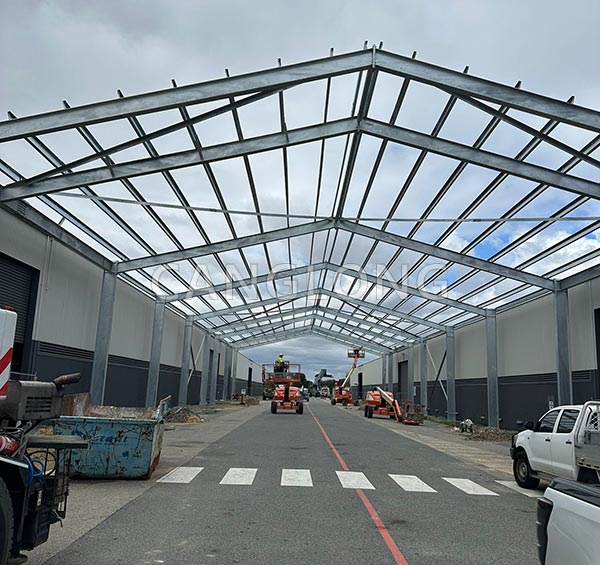
Galvanized Steel Structure Construction
V. 2026 Global Owners’ Procurement Guide
Extreme weather tests the integrity of the entire system. If your steel structure building is procured piecemeal from subcontractors, on-site safety vulnerabilities can easily arise due to missing boxes of wind-resistant high-strength bolts or mismatched corner fitting dimensions.
Based on Canglong Group’s multinational delivery experience, the globally recognized safest construction model in 2026 is the one-stop prefabricated kits model.
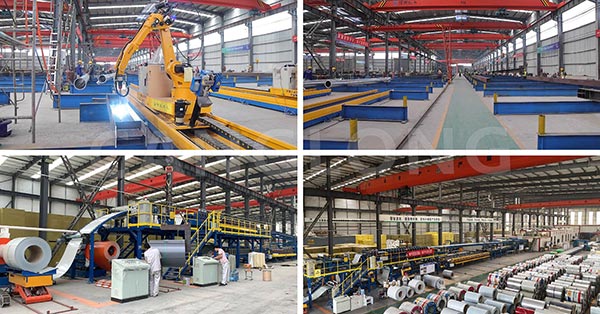
100% Factory Prefabrication: All primary and secondary steel structures undergo full-penetration welding and precision CNC punching within a digital factory using automated welding robots.
On-site Bolted Installation: Upon arrival at the overseas construction site, there is zero on-site welding and zero secondary cutting. Similar to assembling industrial building blocks, this not only eliminates quality risks caused by on-site hot work at the source but also directly halves the high construction time and labor costs overseas.
Canglong Production Workshop
Summary
There is no room for complacency when facing extreme weather. Modern steel building utilizes digital design (BIM), intelligent manufacturing (robotic welding), and cutting-edge materials science (PU/rock wool composite panels, hot-dip galvanizing) to create a definitive mechanical defense for every structural node. Choosing Canglong Group’s one-stop fully prefabricated kit is like purchasing a decades-long super safety insurance policy for your multinational industrial assets.


Send us the inquiry form