In today’s rapidly expanding global industrial real estate market, rapid construction and commissioning have become crucial for companies to seize market share. The pain points of traditional factory construction—long construction periods, low efficiency, and complex procedures—are becoming increasingly prominent. The widespread application of insulated sandwich panels are reshaping the construction logic of prefab factory with an integrated solution, achieving a 40% acceleration in construction speed. This transformation is not only reflected in the record set by Hubei Yihua in China, delivering a 40,000-square-meter factory in 57 days, but is also being continuously validated in industrial projects in Europe and North America.
Traditional factory construction involves multiple processes, including structural erection, insulation layer installation, finishing, and sealing. The coordination between each stage is time-consuming and prone to errors. Insulated sandwich panels integrate structural load-bearing, thermal insulation, and aesthetic finishing into one unit, fundamentally simplifying the construction process—this is the core prerequisite for accelerated construction.
Taking American-made horizontal sandwich panels as an example, after factory prefabrication, on-site wall construction only requires four steps: base preparation, panel assembly, simple fixing, and joint sealing. Compared to the complex process of traditional bricklaying, plastering, insulation board installation, and painting, the efficiency of each process is increased by 3-5 times, naturally resulting in a significant reduction in the overall construction period. The Dominican Republic steel structure cold storage project used this type of integrated component, achieving rapid assembly of 1752 prefabricated components, shortening the construction period by nearly 40% compared to traditional methods.
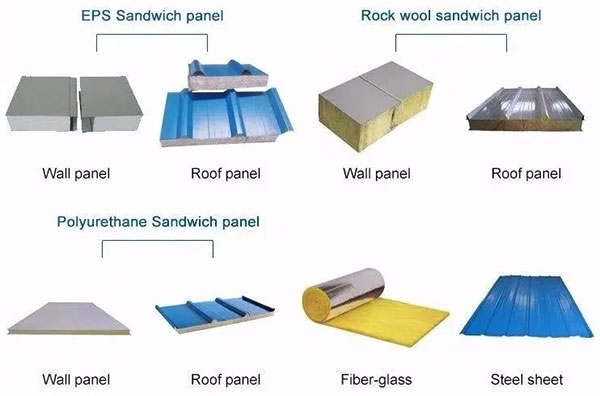
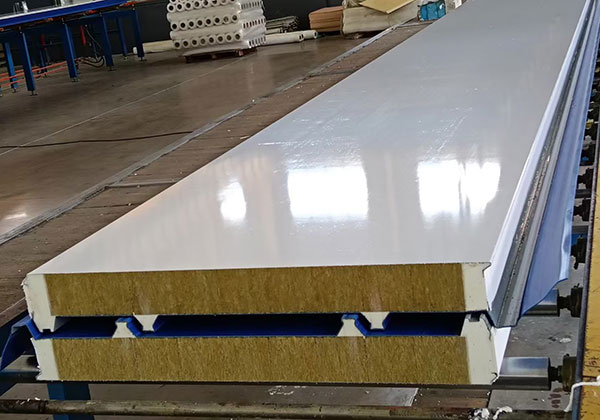
Insulated sandwich panels are produced using automated production lines, allowing for precise customization of dimensions, thickness, and core material type (such as rock wool, polyurethane, vacuum insulation panels, etc.) according to the factory design. The finished product’s precision error is controlled to the millimeter level. This means that large-scale on-site cutting and grinding operations are unnecessary, reducing material waste from 15% in traditional processes to below 3%.
In the Peruvian green factory project, the insulated sandwich panels required for the 40,000 square meter factory building were all prefabricated in the factory. After arriving on site, they were directly hoisted and assembled, completing the main construction in just 126 days, nearly one-third faster than the traditional cast-in-place method. This factory-made parts, on-site assembly model has become the mainstream trend in prefabricated construction.
Innovative connection methods have further amplified construction efficiency. Compared to traditional bolt fixing methods, modern insulated sandwich panels have developed efficient connection technologies such as self-adhesive and slotted connections. Self-adhesive sandwich panels quickly adhere to the substrate using a special adhesive layer, requiring only roller pressure for fixation, eliminating the tedious process of drilling holes point by point. Slotted connections achieve seamless splicing between panels, and with sealant treatment, both insulation performance and installation speed are guaranteed.
In a European automotive parts factory project, the use of slotted insulated sandwich panel allowed eight workers to install 1200 square meters of wall surface per day, four times more efficient than traditional bolt-fixing methods. This low-skill-barrier installation method also reduces reliance on specialized technicians, alleviating the global construction labor shortage.
3. Zero Wet Work, Overcoming Environmental Limitations
In traditional construction, wet work such as concrete pouring and mortar plastering requires waiting for material curing, often taking up more than 30% of the construction period. Insulated sandwich panels are installed entirely using dry methods, independent of weather conditions, and can operate normally even in temperatures as low as -10°C or in rainy environments.
Modified polyurethane sandwich panels have achieved a breakthrough with instant curing after spraying. The material cures within 24 hours after on-site spraying, forming a seamless insulation layer. A North American cold chain factory project utilized this characteristic, completing winter construction unaffected by weather and finishing 18 days ahead of schedule, validating its all-weather construction advantages.
The Value Resonance Behind Accelerated Construction
Currently, prefabricated buildings worldwide are developing towards high efficiency, greenness, and low cost, and the application of insulated sandwich panels perfectly aligns with this trend. In Europe, in response to the “2030 Building Energy Efficiency Directive,” more and more factories are adopting vacuum-insulated sandwich panels, meeting energy-saving requirements while improving construction efficiency. In North America, insulation sandwich panels account for over 60% of modular factory construction, becoming a core component for accelerated construction. In China, driven by the “dual carbon” target, the success of benchmark projects such as Jiangxi Xusen and Hubei Yihua has led to a year-on-year increase in the application rate of insulated sandwich panel.
From a cost perspective, a 40% acceleration in construction means a 70% reduction in labor costs and a 30% reduction in management expenses. Although the cost of high-quality insulated sandwich panel materials is slightly higher, the overall cost is reduced by 10%-15%. This characteristic of improving quality, accelerating construction, and reducing costs has earned it widespread recognition in the industrial building market.
A New Height of Efficiency Enhanced by Intelligent Technology
With the integration of BIM technology and the Internet of Things, the construction efficiency of insulation sandwich panels will be further improved. BIM 3D modeling allows for pre-optimization of panel layout, reducing on-site adjustments. Combined with AR technology, workers can quickly and accurately complete installation. Furthermore, temperature and humidity sensors built into the insulation layer enable real-time monitoring of construction quality.
From integrated components to intelligent construction, insulated sandwich panels are redefining the construction speed of prefab factory. For global industrial investors, choosing insulated sandwich panel is not just choosing a building material, but also choosing an efficient and reliable factory construction solution, providing core support for rapid production and seizing market opportunities.


Send us the inquiry form