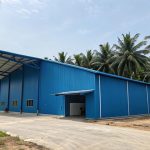
Steel warehouses due to their robust structure and large space, are widely used for industrial storage and logistics transfer. However, metal materials easily transmit sound, and noise from equipment, forklift operations, and cargo collisions often disturbs the surrounding environment and even affects internal operational efficiency. In this case, rock wool board with their unique properties, become an ideal choice for soundproofing steel warehouse.
Why do rock wool board provide sound insulation?
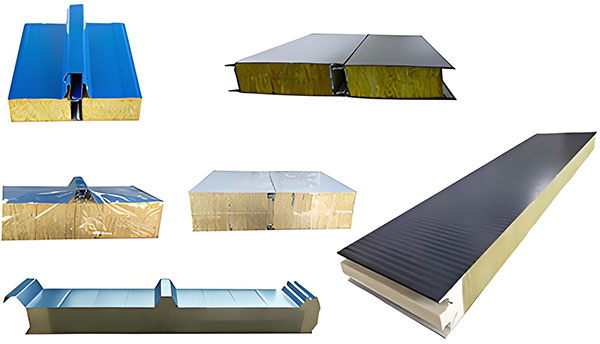
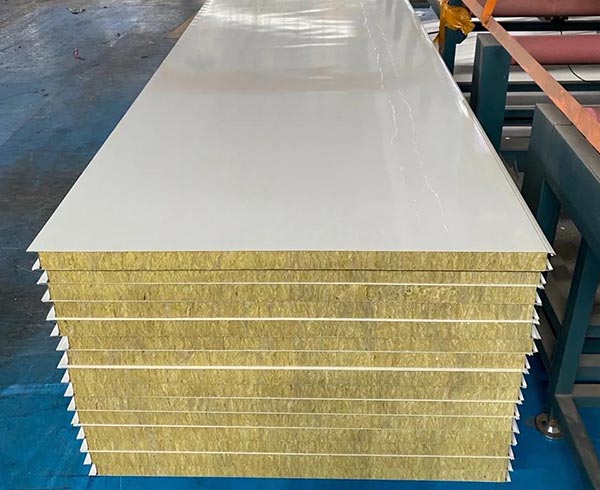
Rock wool boards are made from basalt and other natural rocks melted at high temperatures and then fiberized, resulting in a dense, porous internal structure. When sound waves enter, air molecules in the pores rub against the fibers, converting sound energy into heat energy, thus effectively blocking noise transmission. This dual effect of sound absorption and sound insulation is particularly suitable for rigid sound transmission scenarios in steel structures.
4 major advantages of using rock wool board for soundproofing steel warehouse
1. Significant sound insulation effect
A single layer of 50mm thick rock wool sandwich board can reduce noise by 15-25 decibels, equivalent to the change from a noisy street to a quiet office.
1. Noise Reduction of 30-40 Decibels: With a double-layer board and cavity design, noise reduction reaches 30-40 decibels, meeting the “Emission Standard for Industrial Enterprises at the Boundary.”
2. Class A Fire Resistance: Rock wool is a non-combustible material with a fire resistance rating of A1/A. Its melting point exceeds 1000℃, meaning it will not contribute to combustion even if equipment in a steel warehouse overheats or is exposed to open flames. It complies with stringent fire safety standards such as EU EN13501, US ASTM E84, and Chinese GB 8624.
3. Durable and Resilient:
Moisture-proof: The water-repellent rock wool board has a water absorption rate of <1%, making it less prone to failure even in rainy southern regions or cold storage warehouses.
Anti-aging: The stable inorganic fiber structure eliminates the risk of mold and insect infestation, ensuring a service life exceeding 20 years.
Lightweight and High-strength: With a density of 80-150 kg/m³, it reduces warehouse load while providing impact resistance, making it suitable for scenarios with frequent forklift operations.
4. Environmentally Friendly and Healthy
Free of formaldehyde, asbestos, and other harmful substances, certified by EU REACH and US GREENGUARD.
Low-carbon production process; recyclable after disposal, aligning with global green building trends (e.g., LEED, BREEAM).
Which steel warehouse scenarios most require rock wool board sound insulation?
Industrial manufacturing warehouses: High noise levels from machining and stamping equipment, rock wool panels on walls/ceilings protect workers’ hearing.
Logistics transit warehouses: Forklift, packing machine, and truck loading/unloading noise disturbs residents, rock wool boards in partition walls reduce complaints.
Temporary construction warehouses: When near residential areas, quick installation of rock wool sandwich panel enclosures reduces construction noise.
Cold chain warehouses: Maintains sound insulation performance even in low-temperature environments without affecting thermal insulation; can be used in conjunction with insulation layers.
Installation Points
Choose the right thickness: Depending on the noise source intensity, 50-100mm thick rock wool boards are sufficient. For example, use 100mm in equipment areas and 50mm for general storage.
Fixing: Secure to the steel wall/roof using a special keel or adhesive, sealing joints with sealant to prevent sound leakage.
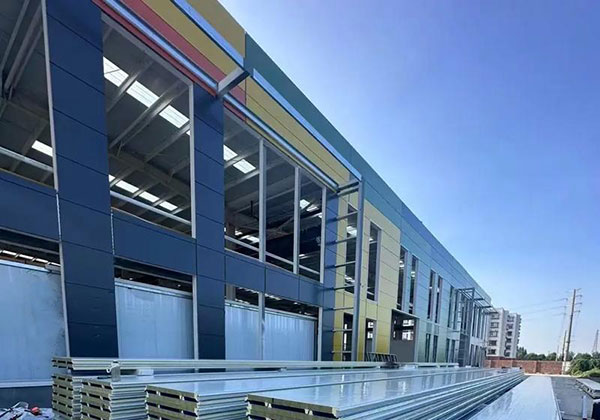
Surface Treatment: The exterior can be covered with color steel plates, gypsum board, or other finishes, enhancing both aesthetics and overall integrity.
Summary
For steel warehouses, rock wool board is not only sound insulation materials but also multifunctional materials that combine safety, durability, and environmental friendliness. Whether it’s reducing internal noise, minimizing external disturbances, or meeting fire safety regulations, it provides a cost-effective solution.



Send us the inquiry form