When 60,000 spectators enjoy unobstructed views at the football stadium of a sports center, and when the ice surface of the speed skating rink is completely covered by a 102-meter-span roof, large-span steel structures are redefining the construction standards of global sports venues as column-free space magicians. This structural form, capable of easily spanning distances exceeding 60 meters, has become the preferred solution for major sporting events such as the World Cup and the National Games due to its core advantages of high space utilization, excellent seismic performance, and rapid construction efficiency. Furthermore, it is embarking on a new journey driven by green construction and intelligent technologies.
1. Why Do Sports Venues Prefer Large-Span Steel Structures?
The special spatial requirements of sports venues—unobstructed spectator views, flexible layout of competition areas, and gathering areas capable of accommodating tens of thousands of people—perfectly match the characteristics of large-span steel structures. Its core advantages are reflected in three dimensions:
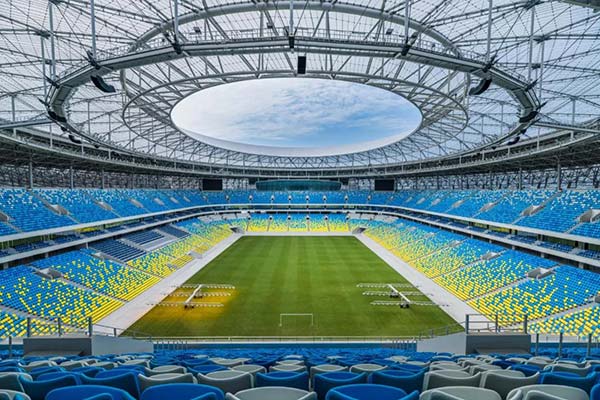
First, the ability to liberate space. Traditional concrete structures rely on dense columns for load-bearing, while steel structures, through the mechanical synergy of cables and steel rods, can achieve a clear span of over 200 meters. The Phoenix Mountain Sports Park football stadium in Chengdu, China, features the world’s first large-aperture cable-stayed dome structure. 561 cables intertwine to form a giant silver net, providing unobstructed views for 60,000 seats across a 200-meter span, with a maximum cantilever of 64 meters. This characteristic allows the stadium to meet the needs of football matches while also being quickly converted into concert or exhibition venues, maximizing its multi-functionality.
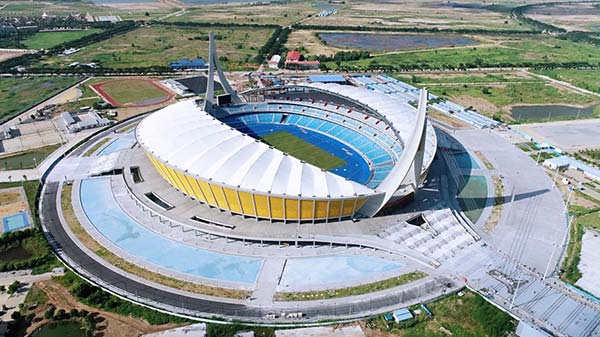
Secondly, it strikes a balance between safety and efficiency. The steel structure weighs only one-third that of a concrete structure, yet its seismic performance is improved by over 50%, making it particularly suitable for earthquake-prone areas. In the Sihanoukville Sports Complex project in Cambodia, an 1,800-ton steel connecting corridor was precisely hoisted to a height of 60.5 meters using 16 hydraulic lifters, with millimeter-level control precision ensuring structural safety. Furthermore, steel structural components can be prefabricated in the factory and assembled on-site, shortening the construction period by more than 30% compared to traditional methods, meeting the urgent construction needs of major events.
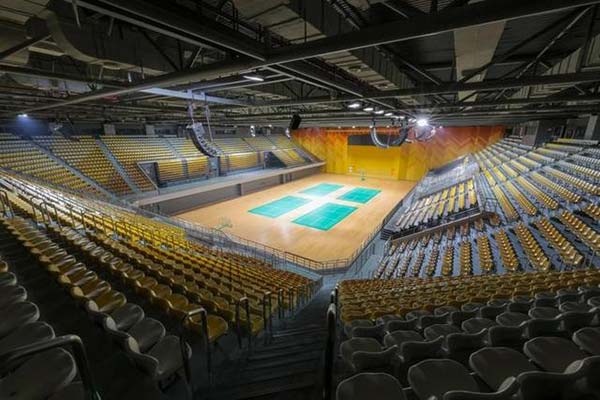
Finally, it possesses the potential for innovative form. Steel trusses and cable domes can be used to create complex shapes such as curved surfaces and saddle shapes, making stadiums urban landmarks. The Foshan Desheng Sports Center Gymnasium in China, with its 124-meter span cable dome structure, is the largest cable dome stadium in China with a closed roof. Its spine cable, diagonal cable, and ring cable system achieves both mechanical optimization and presents an architectural beauty like a pearl.
2. From Single Load-Bearing to a Balance of Rigidity and Flexibility
With technological iteration, large-span steel structures have evolved from traditional trusses to multi-system integrated composite structures, adapting to different climates and functional requirements, forming a distinctive feature among stadiums worldwide.
Cable Dome Structure: A Lightweight and Efficient Spatial Network As the most competitive system currently available, the cable dome bears load through a tension field formed by tension cables, using only 1/5 the steel of traditional structures. Besides the Chengdu Phoenix Mountain Stadium, the Guangdong Desheng Sports Center Gymnasium also features a cable-stayed dome structure with a long axis span of 124 meters, the longest among indoor stadiums in China. Its central ring is lifted 38 meters into the air via an intelligent hydraulic system, with a 160-ton cable net precisely positioned. This system is particularly suitable for tropical regions, such as Southeast Asian stadiums, where its lightweight properties allow it to withstand typhoon loads.
Trunking Structure: A flexible, rigid framework composed of tubular members, the tubular truss combines rigidity and aesthetics, allowing for the construction of arches, curves, and other arbitrary shapes. Nodes do not require complex connecting plates, making rust prevention and maintenance easier. The Jinan Yellow River Sports Center football stadium in China uses 88 tubular trusses, each weighing 200 tons, assembled at a height of 60 meters to form a roof with a diameter of 280 meters, achieving a maximum cantilever of 45 meters, setting a domestic record. Early large stadiums in Europe and America often adopted this system; for example, the curved roof of the Allianz Arena in Munich, Germany, uses a tubular truss as its core framework.
Composite Innovative Structures: Customized solutions tailored to specific needs drive global engineers to continuously push the boundaries of systems. The Wangjiawan Speed Skating Oval in Shenyang, China, pioneered a 102-meter span tensioned timber arch steel frame hybrid structure, combining steel trusses with timber beams to meet ultra-low energy consumption requirements while reducing steel usage by 600 tons. The Jinan Yellow River Sports Center innovatively applied a CFRP-steel cable composite truss, combined with high-transmittance PTFE membrane material, ensuring sufficient light for the lawn while increasing tensile strength by 30%.
3. Smart and Green-Driven Technological Innovation
In 2024-2025, the construction of large-span steel structure stadiums globally will exhibit a clear trend towards digital empowerment and low-carbon priority, with technological breakthroughs concentrated in two major areas: construction control and performance upgrades.
Intelligent construction has become the core of precision. BIM (Building Information Modeling) and finite element simulation technologies have enabled full-process pre-visualization of construction. The Cambodian steel corridor project completed tens of thousands of mechanical calculations using MIDAS software, identifying and reinforcing structural weak points in advance to avoid rework at heights. The Jinan Yellow River Sports Center, in collaboration with universities, developed digital construction technology that uses laser scanning to generate point cloud data, automatically detecting component dimensional errors and controlling the closure accuracy within 5 millimeters. More advanced intelligent monitoring technologies have been implemented; the Desheng Sports Center has embedded fiber optic grating sensors in its cables to transmit cable force data in real time, enabling dynamic early warning of structural health.
Green and low-carbon have become mandatory indicators. The “dual carbon” goal is driving the development of steel structures towards circularity and low energy consumption. The Shenyang Wangjiawan Speed Skating Oval reduces carbon emissions through a steel-wood hybrid structure, achieving a 100% wood recycling rate. Globally, the steel recycling rate for stadiums has generally increased to over 90%, and of the 8,000 tons of steel used in the Desheng Sports Center, 30% is recycled steel. Simultaneously, the cable-membrane synergy system reduces artificial lighting energy consumption through translucent membrane materials, and wind-resistant design software developed by Chongqing University optimizes the cable-membrane morphology to reduce wind load, further improving energy efficiency.
4. From Technology Export to Standard Integration
Large-span steel structures have become an important carrier of Chinese architectural technology. From millimeter-level hoisting in the Sihanoukville Port complex in Cambodia to typhoon-resistant design for Southeast Asian venues, Chinese companies are combining core technologies such as BIM and intelligent hydraulic lifting with local standards to achieve adaptive technological innovation. In China, the large-aperture cable-stayed dome of the Phoenix Mountain Stadium and the intelligent cable application at the Desheng Sports Center have already established exportable technical standards.
In the future, with the development of 3D-printed steel structures and new composite materials, large-span sports stadiums will achieve breakthroughs in even greater spans, lighter weights, and lower energy consumption. This structural form, integrating mechanical intelligence, architectural aesthetics, and green concepts, will not only support more global sporting events but also become a new landmark for urban sustainable development.

Send us the inquiry form